Trust
Codependency and Narcissism Relationships: Untangling the Web

Codependents and narcissists seem to be a match made in heaven…or hell. Inexplicably drawn to each other, their relationship resembles a tangled web, intertwined but fragile. Though the codependent partner attempts to exert control by meeting the other’s needs, the narcissistic partner is often controlling, self-focused, and egotistical.
While we are not big on labels, people who come to PIVOT seeking help in their relationships often use these descriptions to characterize their partners. Although the labels may not be entirely accurate, there is usually a deeper truth to uncover. If you need help untangling the web of a codependency and narcissism relationship, PIVOT is here to help.
Why Are Codependents and Narcissists Drawn to Each Other?
Understanding the complex dynamics of codependency and narcissism can bring a sense of relief and hope. By appreciating the typical character traits of both partners, we can begin to untangle the web of this complex relationship. Despite the challenges, there is a path to healing and healthier future relationships.
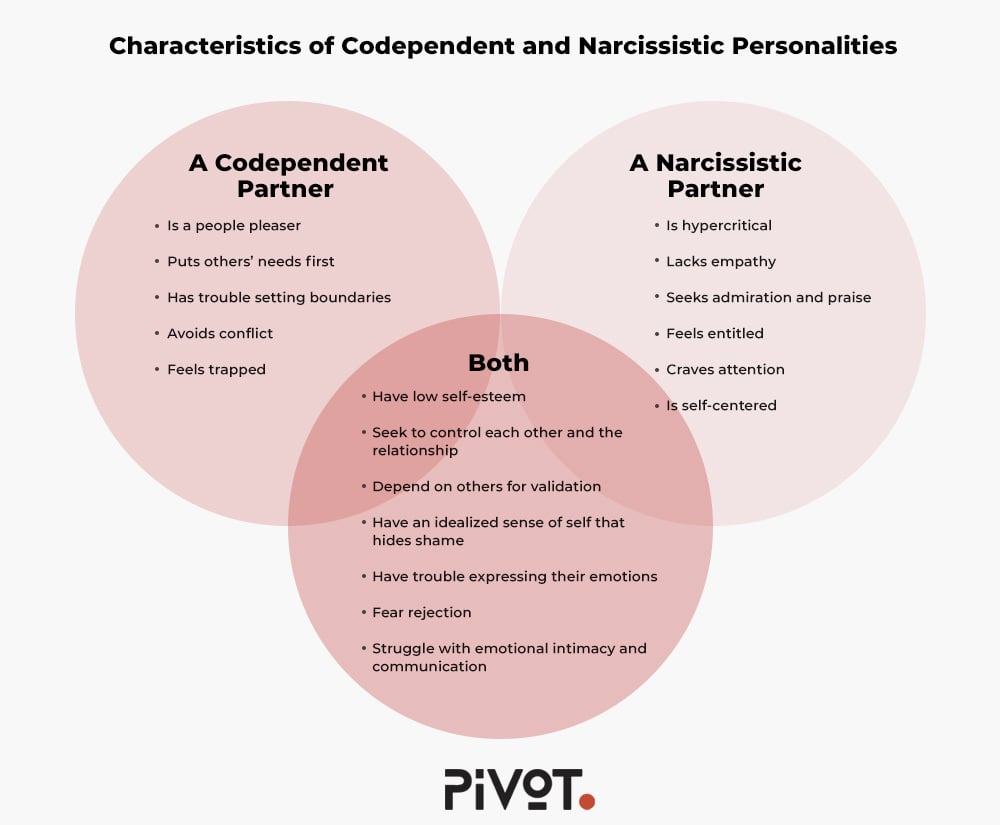
In broad strokes, the two sides of this dynamic tend to look like this:
- The codependent partner may seek to feel needed, meet the other person’s needs to keep the peace, depend on being helpful for validation, and quietly give up their own wants and boundaries.
- The narcissistic partner may seek to feel important, expect attention and admiration, and can be controlling or self-focused, while depending on others’ validation just as heavily.
It is not clear whether their similarities or their differences draw them together, but the pairing of codependent and narcissistic partners is inherently unstable. Both exhibit a series of codependent characteristics that lead to intimacy issues in their relationships. While a codependent partner may be subject to narcissistic abuse, typically, both partners are suffering in this dysfunctional relationship. To be clear: where abuse is present, it is never the abused partner’s fault, and mutual dysfunction is not the same thing as abuse.
Healing for Codependency and Narcissism Relationships
At PIVOT, we understand that adult relationship issues often stem from childhood trauma and early attachment wounds. Our process involves revisiting your past and changing your relationship with it to pave the way for healthier future relationships.
As humans, everyone is capable of giving and receiving love. However, some of us need help sorting out our baggage before we can untangle the web of a dysfunctional relationship. PIVOT coaches can help you do just that. By replacing unhealthy coping mechanisms and survival patterns, you can make room for healthier behavior more conducive to fulfilling, reciprocal relationships.
Seeking Help for Codependency
If you see yourself in the role of a codependent partner, we are here to help you PIVOT away from the same ineffective behavior patterns that have you stuck in this painful relationship. Once you have the desire and motivation to change, we will meet you where you are and help you to forge a different path forward.
Our relationship coaches have expertise in untangling the intricate dynamics of interpersonal relationships. Even the complexities of the codependency and narcissism relationship are no match for the PIVOT Process.
Your PIVOT coach will help you to:
- Gain confidence in yourself
- Connect with your own wants and needs
- Set and maintain healthy boundaries
- Make decisions that benefit you
- Learn to communicate more effectively
If you are in a codependent relationship and want to make a positive change in your life, remember that you are not alone. PIVOT is here for you.
Codependency Quiz
Wondering how deep the codependent side of this dynamic runs for you? See how strongly the pattern shows up.

Creating Lasting Change for Narcissistic Behaviors
If you recognize any of the narcissistic traits in yourself, it's important to remember that you have the power to change. These traits may prevent you from having healthy, fulfilling adult relationships, but with support, you can replace these ineffective and troubling behaviors with healthy actions. By learning new strategies for making solid and supportive attachments, you can take control of your relationships and your life.
Your PIVOT coach will:
- Help you develop a realistic self-image
- Encourage empathy for others
- Help you establish your recovery goals
- Provide sequential assignments for taking positive action
- Be available between sessions via text, phone, or email
If you recognize narcissistic patterns in your own behavior in your closest relationships, it's important to remember that healing is possible. The PIVOT Process empowers you to make lasting behavioral changes. By acknowledging your behavior and committing to change, you can take the first step towards a healthier, more fulfilling future.
FAQs
The answer to this question is not clear-cut; narcissism and codependency often overlap. One wants to feel important, while the other wants to feel needed. Their core shared characteristic is they depend on others for validation.
A narcissist may use abusive tactics, such as projection, to manipulate their codependent partner into believing they are, in fact, narcissistic. However, it is also possible that a codependent partner displays narcissistic tendencies at times as a result of childhood trauma, making it quite challenging to decide whether they are codependent, narcissistic, or both.
Deciding to take control of your life and free yourself from narcissistic abuse is a brave move, but true healing takes time. Allow yourself some grace as you make this transition. Practice self-care and identify a support network. A PIVOT relationship coach has the expertise to advise and support you as you break this painful cycle and find your inner strength.
It is not clear whether their similarities or their differences draw them together, but the pairing is inherently unstable. One partner wants to feel important while the other wants to feel needed, and both depend on others for validation, a shared trait that locks the dynamic in place.
The PIVOT Process starts with your own life story. As you work through it, you create a living document, a toolkit, to support you as you approach future relationships. This universal process is used in every PIVOT program, whether weekly coaching, intensive, or retreats. Clients consistently tell us how much they get from the program and how quickly they experience change.
Both partners are capable of change. PIVOT works with each partner individually to replace unhealthy coping mechanisms and survival patterns, making room for healthier behavior and healthier future relationships.
PIVOT offers two types of Narcissistic Retreats: one for partners with narcissistic tendencies and a separate retreat for partners who have suffered narcissistic abuse. Both take place at The Glass House in Northern California. Groups are limited to 6 gender-specific clients, and the program offers yoga, meditation, healthy meals, and personal and group meetings.
We focus on high-impact solutions to this challenging relationship dynamic. Whether you’re working through replacing unhealthy coping mechanisms or letting go of codependency, we will help you identify your needs, set and maintain boundaries, and prepare to cultivate healthier relationships in the future.
Learn more about our retreats here.

Transform Your Relationships With PIVOT
PIVOT coaches have the expertise required to untangle codependency and narcissism relationships. We will work with each partner individually to facilitate lasting behavioral change. Contact us today if you are ready to break the painful cycle and experience true relational freedom. You can reach us at 1-855-452-0707.