

Narcissistic. Avoidant. Or Armored?

We’re living in a time where the conversation about men feels charged.

With Trump in office, whether you support him or not, and with the release of the Epstein files bringing renewed attention to powerful men behaving badly, there is a cultural undercurrent that is hard to ignore.

A lot of men are taking a fall publicly.
Some absolutely deserve it.
And many innocent men are quietly sitting in discomfort.

Because when headlines are dominated by abuse, corruption, and power misused, the message can subtly become: men are the problem.

That narrative is too simple. And it’s not true.

Not all men are dangerous.
Not all men are narcissistic.
Not all men are emotionally unavailable.

But in this climate, many men feel scrutinized. Some feel defensive. Others feel ashamed for things they didn’t do. And in relationships, that tension often shows up in subtle ways, such as withdrawal, overcompensation, silence, or posturing.

Which is why this matters.

Because when cultural pressure rises, labels rise with it.

He doesn’t text back fast enough? Avoidant.
He struggles with vulnerability? Narcissistic.
He shuts down in conflict? Emotionally unavailable.

But here’s what I’ve learned after nearly two decades of working with men and women in relationships:

Many men who are labeled narcissistic aren’t arrogant. They’re armored.
Many men who are labeled avoidant aren’t cold. They’re cautious.

And labels don’t create change. Clarity does.

1. The Weight Men Are Carrying

In the Survival Patterns work within the PIVOT curriculum, the question isn’t:

“What’s wrong with you?”

It’s:

“What did you learn to do to survive?”

A man who has been called narcissistic is often operating from:

  • Unresolved shame
  • Performance-based worth
  • Fear of inadequacy
  • A survival strategy of control, grandiosity, or self-protection

A man called avoidant is often operating from:

  • Fear of engulfment
  • Fear of being exposed as not enough
  • Early experiences where emotional needs were ignored, criticized, or unsafe

Instead of defending against a label, he begins to see:

“Oh. This isn’t my identity. This is a pattern.”

That distinction restores a step toward dignity.

2. Structure Before Emotion

The Whole Perspective (Physical, Emotional, Spiritual, Financial, Intellectual) allows him to assess himself with clarity rather than emotion-driven chaos.

This is critical for men who:

  • Default to logic
  • Distrust emotional language
  • Shut down when conversations feel abstract or accusatory

He can see:

  • Where he’s strong
  • Where he’s compensating
  • Where his relational blind spots live

Structure reduces defensiveness.

3. Clarity Creates Boundaries — Not Blame

The Relational Circle Boundaries give him a system for defining commitment levels and expectations.

Men labeled “avoidant” often withdraw because:

  • They feel engulfed and confused.
  • Expectations are unclear.
  • Emotional demands feel overwhelming.

When boundaries are clear:

  • He doesn’t have to escape.
  • He can participate without drowning.
  • He can differentiate between healthy space and emotional shutdown.

Avoidance decreases when clarity increases.

4.  From Ego or Escape to Healthy Adulting

The pivot point is the development of the Healthy Adult.

This is not:

  • Ego-driven dominance (often labeled narcissism)
  • Emotional shutdown (often labeled avoidance)

It is:

  • Regulated thinking through a wider lens (Think)
  • Integrated feelings instead of ignoring or suppressing them (Feel)
  • Intentional action vs. habitual actions that cause self-harm in the long run (Do)

For men, this is powerful because:

  • It doesn’t shame their strength.
  • It channels their strength.
  • It builds secure attachment without making them feel weak.

5.  Moving Beyond Labels to a Roadmap 

As I write in my book, I believe we live in an “over-diagnosed and under-treated population.”

Many men experience the same thing in relationship language today.

They’ve been:

  • Diagnosed by a partner.
  • Labeled on TikTok.
  • Defined by pop-psych culture.

PIVOT offers something different:

  • Not a diagnosis.
  • Not a defense.
  • A roadmap.

And men respond to roadmaps.

6. Secure Attachment, Taught Practically

The curriculum explicitly teaches secure attachment and relational alignment in a grounded, actionable way.

For a man told he’s narcissistic or avoidant, this reframes the journey:

Not: “You need to fix your personality.”

But: “You need to learn secure alignment.”

That is doable.
That is empowering.
That is measurable.

7. From Power Struggles to Self-Leadership

Men labeled narcissistic often struggle with vulnerability, confuse control with safety, and fear of loss of status in the relationship.

Men labeled avoidant often fear engulfment, shut down under emotional pressure, and eventually exit relationships rather than repair.

In simple terms, for a man told he’s narcissistic or avoidant, the PIVOT Process:

  • Removes the shame by removing the label
  • Names the survival patterns and developmental parts unique to each individual
  • Provides a structured, easy-to-understand process to address the not-so-easy current challenges that need to be resolved.
  • Builds emotional regulation
  • Teaches secure attachment
  • Develops a Healthy Adult identity
  • Gives him agency instead of blame

It shifts him from: “I’m the problem.” or “You’re the problem.”

To: “I have wounds. I can change my patterns.”

A More Courageous Conversation About Men

If we’re honest, this cultural moment is asking something bigger of us.

Yes, there have been powerful men who abused power.
Yes, there are patterns in our society that must be addressed.
Yes, accountability matters.

But here’s the question we’re not asking:

What happens when good men start believing they are guilty simply for being men?

What happens when shame becomes the default tone of the conversation?

Shame does not create healthier men.
Shame creates silence.
Shame creates defensiveness.
Shame creates more armor.

And more armor does not lead to safer relationships. It leads to distance.

If we want better outcomes in families, in leadership, in culture, we cannot reduce men to headlines. We cannot collapse nuance into narrative.

We need to be able to hold two truths at once:

Some men have misused power.
And many men are trying to figure out how to use their power well.

Those are not the same group.

The men I work with are not asking to escape accountability. They’re asking for clarity. They’re asking for a roadmap. They’re asking how to lead themselves better in relationships, not how to defend themselves on the couch or in court.

There is a difference.

When we replace labels with understanding…
When we replace accusation with structure…
When we replace shame with responsibility…

Men don’t shrink. They mature. They regulate. They repair. They lead differently.

If we want a generation of men who are less reactive, less avoidant, less performative, then we need to stop flattening them into stereotypes and start teaching them alignment.

True strength is not the opposite of emotional intelligence. A man who must explode or withdraw to manage his feelings is not strong; this is control masking an underlying fragility.

Accountability and dignity are not mutually exclusive. Holding a man accountable for his actions should never mean stripping him of his dignity or humanity. Justice and humiliation are not the same; confusing them prevents growth and only teaches him to hide his behavior. It is possible and necessary to demand accountability while upholding his dignity.

Powerful and relationally safe are not competing traits. Real power is not domination; it is disciplined self-leadership in the presence of emotion.

If we keep defining masculinity by extremes, either villain or victim, we will keep producing men who swing between those extremes.

If we want emotionally mature men, we must stop flattening them into labels and start teaching them how to feel, tolerate, and manage their emotions.

If you want safer relationships, build stronger men, not smaller ones.
If you want accountability, teach self-leadership, not shame.
And if you want armor to come off, create an environment where strength and emotional depth are no longer at war.

Because the future of healthy relationships will not be built by shaming men into silence
It will be built by teaching them to stand tall without standing over others.

But none of that grows in an environment of blanket shame. It grows in clarity.

So if you’ve been labeled narcissistic, avoidant, or emotionally unavailable, here’s the truth:

You are not your headline.
You are not your defense mechanism.
You are not your worst coping strategy.

You may be armored. And armor can come off.

Not through humiliation.
Not through blame.
But through insight, structure, and the willingness to pivot.

That’s the conversation we need now.

Why So Many Good Men Struggle on Dating Apps and What to Do About It

There are good men everywhere. Men with careers. Men who go to therapy. Men who read books. Men who want partnership, not games.

And yet…
They’re frustrated. Discouraged. Confused.
Swiping endlessly. Matching rarely.
Or matching often, only to watch it go nowhere.

This isn’t because men are “broken.”
And it’s not because dating apps are evil.

It’s because most men are dating without being clear-headed and regulated.

And without alignment, even a good man can look unclear, reactive, or misaligned online.

At PIVOT, we don’t pathologize. We personalize.
And when it comes to dating apps, personalization matters.

The Real Problem: Fantasy vs. Reality

In #HealthyAdult, I discuss moving from fantasy to reality, confusion to clarity, and isolation to connection.

Dating apps amplify fantasy.

  • Fantasy about who you “should” attract
  • Fantasy about what a partner “should” look like
  • Fantasy about how quickly it “should” happen
  • Fantasy about what it means if someone doesn’t respond

And fantasy is dangerous when your old survival patterns are running the show.

When a man swipes based on ego, image, or scarcity, he’s not dating with direction. He’s dating from a wound.

When a woman presents an unrealistic checklist, and a man contorts himself to qualify — that’s not confidence. That’s old attachment anxiety dressed up as effort.

Dating apps don’t create insecurity.
They expose it.

Why Good Men Get Discouraged

Here’s what I see again and again:

1. They Don’t Know Their Own Standard

If you don’t know what you are looking for beyond “attractive, nice, successful,” you will chase what feels validating, not what is aligned.

And validation fades quickly.

2. They Over-Index on Being Chosen

When a man measures his worth by matches, he’s handing strangers control of his self-concept.

That’s a survival pattern.

In the PIVOT curriculum, we teach clients to understand the Whole Perspective, physical, emotional, spiritual, financial, and intellectual, so they see themselves clearly and date from reality, not insecurity.

3. They Confuse Chemistry with Compatibility

Intensity is not alignment.
Attention is not intimacy.
Sexual energy is not relational safety.

Without clarity, men chase sparks and ignore substance.

How PIVOT Helps Men Date with Direction

At PIVOT, our goal is simple:

Help people THINK better, FEEL better, and LIVE better.

Here’s how that applies directly to dating apps.

1. Whole Perspective: Know Who You Are Before You Swipe

Before you evaluate anyone else, you need to evaluate yourself — across your Whole Perspective.

  • Physical: Are you taking care of your body? Sleeping, training, eating well — or running on stress and adrenaline while expecting someone else to stabilize you?
  • Emotional: Can you manage disappointment, rejection, and uncertainty without spiraling — or are you dating to soothe loneliness or regulate anxiety?
  • Spiritual: Are you living from your values and sense of purpose — or are you swiping in ways that contradict the kind of life you actually want to build?
  • Financial: Are you financially steady and responsible — or are you using status, spending, or image to signal worth instead of building substance?
  • Intellectual: Are you growing, curious, and thoughtful — clear about what kind of partner fits your life — or just reacting to who validates you?

When a man understands his Whole Perspective, he stops chasing fantasy profiles and starts evaluating alignment.

He moves from “Do they like me?” to “Is this healthy for me?”

That shift alone changes everything.

2. Relational Circle Boundaries: Stop Over-Investing Early

One of the biggest mistakes men make on apps?

They give girlfriend-level energy to someone they’ve never met.

Texting constantly. Oversharing. Future pacing.

Relational Circle Boundaries teach you how to define the appropriate level and timing of access.

Boundaries are not walls. They are clarity.

When you date with boundaries:

  • You don’t chase mixed signals.
  • You don’t negotiate your values.
  • You don’t escalate prematurely.
  • You don’t ghost

You stay grounded. You have conversations. You lead with respect for yourself and others.

3. Survival Patterns: Don’t Let Your Past Pick Your Partner

We are all drawn to what is familiar, regardless of merit.

That means:

  • If you grew up chasing approval, you’ll chase avoidant women.
  • If you learned love equals intensity, you’ll chase drama.
  • If rejection triggers abandonment, you’ll over-pursue.

Until you identify your survival patterns, they will run your dating life.

Dating apps accelerate this cycle because the volume is high and the rejection is frequent.

But when you can say: “Oh. That urge to triple-text? That’s my anxiety talking.”

You’ve already pivoted.

What About Unrealistic Expectations?

Let’s address the elephant in the room.

Yes, some profiles project unrealistic standards for what they want on a partner:

  • Six figures.
  • Six pack.
  • Six feet.
  • No baggage.
  • No complexity.

You can rage against it.

Or you can remember this:

A checklist tells you about their readiness, not their worth.

If someone needs a fantasy man, let her have him.

Your job is not to qualify for fantasy.  Your job is to embody reality.

And reality, when aligned, is magnetic.

Dating From the Healthy Adult

In #HealthyAdult, I describe becoming someone who can feel, manage, and tolerate their feelings without making others responsible for them.

Imagine dating apps from that place.

  • You don’t spiral when someone unmatches.
  • You don’t inflate when someone compliments you.
  • You don’t collapse when someone ghosts.

You evaluate. You adjust. You move forward.

No drama.
No self-abandonment.
No desperation.

Just direction.

The Shift That Changes Everything

Most men ask:

“How do I get more matches?”

The better question is:

“How do I become more aligned?”

Because aligned men:

  • Choose better.
  • Communicate clearly.
  • Walk away sooner.
  • Invest intentionally.

And that is attractive on and off the app.

If You’re a Man Feeling Frustrated Right Now

Here’s what I want you to hear:

You are not behind.
You are not inadequate.
You are not invisible.

But you may be dating from confusion instead of clarity.

And clarity is trainable.

You don’t need to fix yourself. You need a better framework.

The PIVOT Process exists to help you move from fantasy to reality, from confusion to clarity, and from isolation to connection.

Dating apps are not the enemy. Unexamined patterns are.

The next time you open an app, pause before you swipe.

Ask yourself:

Am I dating to prove something or to build something?

That answer will tell you everything.

If you’re ready to Date with Direction, this is your moment to pivot.

Coaching for Narcissistic Abuse: Take Your Life Back

Dealing with narcissistic abuse can be draining and downright devastating. You may feel like you can’t do anything right, often experiencing emotional abuse that leaves you questioning your worth. You might be riddled with doubt and questioning your recollection of conflicts and conversations. You may feel alone, depressed, and anxious. As your self-confidence erodes and you feel increasingly isolated, your family and friends may recognize the problem long before you do. 

Narcissistic abuse may not be evident or easily recognizable to you at first, especially in the context of a close relationship. Though physical or sexual abuse may be easy to spot, narcissistic abuse is often largely emotional and much harder to recognize. It’s also hard to accept and admit to yourself that you are in this situation. This prolonged emotional and psychological distress can lead to complex trauma, requiring specialized support for recovery.

If you have identified this type of abuse in a close relationship, you may be angry, hurt, and unsure where to turn. PIVOT can help. Our coaching for narcissistic abuse is second to none and has been instrumental in facilitating change for thousands of our clients. 

Let PIVOT help you take your life back.

Coaching for Narcissistic Abuse: Finally Break Free

The fact that you are here reading this means you’ve already gone through the painful journey of recognizing and accepting the toxic dynamics you are stuck in. You may feel like you don’t know whom to trust or where to turn for help.

Our relationship coaches are uniquely trained to help you take decisive action. They can help you to overcome the damage narcissistic abuse causes to your self-image and confidence and build yourself back up to a place where you can enjoy life again on your own terms.

How Coaching for Narcissistic Abuse Can Help Mediate Change

You Want to Feel:

Coaching Helps You To:

Like you are a priority

Put yourself first. This step is essential to healing and motivating behavioral change. Start taking care of you!

A sense of self-esteem

Recover a healthier sense of self to empower lasting behavioral change.

Free from toxic cycles

Understand attachment styles and why you may choose a certain type of partner.

Free of shame

Learn to recognize and resist manipulation. View yourself and your relationships through a different lens.

Decisive about your life

Rediscover your decision-making confidence, which is often undermined by narcissistic abuse.

Healthy

Learn how trauma impacts your physical and mental health. Adopt a supportive self-care ritual.

Hopeful

Know that there is a way out and that you won’t always feel this way.

The PIVOT Difference: Coaching for Narcissistic Abuse

At PIVOT, we take pride in our unique interventional approach, developed in a clinical setting over many years with thousands of clients. The focus is on you–your personal needs and individual circumstances. We offer those experiencing narcissistic abuse a well-worn pathway to healing, and we support you every step of the way.

The PIVOT Difference

Our Process

The PIVOT Process is a transformative journey that helps you to understand and love yourself. It starts with examining your own developmental psychology as you revisit your childhood, teen/adolescent, and adult years. You will look at yourself through a wide lens as you examine the physical, intellectual, emotional, spiritual, and financial aspects of your life. This process is not just about healing; it’s about discovering your potential for change and growth.
With newfound understanding, the second part of the process empowers you to create behavioral change through actionable systems and tools. Connecting your thoughts and feelings with action, you will learn to reframe negative behavior patterns, set healthy boundaries, and form secure attachments. The result will be greater resilience and relational freedom in your future relationships.

Our Coaches

PIVOT coaches are not just experts in coaching for narcissistic abuse, they are also compassionate allies on your healing journey. Located across the U.S., each coach brings a rich diversity of professional therapeutic expertise, knowledge, and life experiences to their work. Your coach will be there for you, providing the support and understanding you need to build healthier, happier relationships.

Our Impact

With thousands of clients served, our impact is evident in their reviews and testimonials. The feedback we receive regularly includes phrases like “life-changing,” “deeper understanding of myself,” “empowering,” and “wish I had done this sooner.” These testimonials are a testament to the transformative power of our coaching for narcissistic abuse.

Our Options

While weekly in-person or virtual coaching for narcissistic abuse is an effective way to begin the healing process, many people who have experienced this devastation prefer to accelerate their recovery with a 1- or 2-day personalized PIVOT or a 5-day relationship retreat. These intensive options offer the opportunity for a deep dive into the forces that have shaped your relationship and left you vulnerable to narcissistic abuse.

How PIVOT Can Help You Escape Narcissistic Abuse and Rebuild Self Worth

The results of long-term narcissistic abuse undermine your confidence and eliminate your agency. You may find yourself struggling with your mental health and fending off physical health ailments, trapped in a merry-go-round of trauma and pain. If you have a close personal relationship with someone with narcissistic personality disorder or a person with narcissistic traits, it is time to save yourself. 

PIVOT coaches are trained to help you break this painful cycle and take back your life. The PIVOT Process is universally applicable and infinitely customizable. It can be adapted to your circumstances and help you find a way forward. This recovery journey emphasizes the importance of guidance, personal growth, and restoration of self-worth.

Don’t try to do it alone. Let us support you with our proven process and empower you with a toolbox of actionable strategies to facilitate healthier communication, reasonable boundary setting, and compassionate self-care. Developing self awareness is crucial; if you recognize narcissistic abuse in a close relationship, it’s time to plan your exit strategy.

Heal Your Relationships With PIVOT: The Healing Process  

PIVOT offers compassionate and transformative coaching for narcissistic abuse through weekly sessions, personalized intensives, and Glass House retreats. Our approach emphasizes the importance of self love in your healing journey. Reach out to begin your journey to a healthier, happier life. You can reach us at 1-855-452-0707. Don’t wait any longer to take back control of your well being and life.

How to Break the Cycle of Narcissistic Abuse Once and For All

The cycle of narcissistic abuse is characterized by ups and downs. When times are good, they may seem too good to be true. Unfortunately, the bad times take a toll. By the time you recognize the toxic nature of this roller-coaster relationship, there may be significant damage to your sense of self. You may feel broken, hopeless, and lost.

Know this: you aren’t alone. PIVOT is your dedicated support system, standing by your side. We can help you build back your trust in yourself and your sense of hope. Let us help you learn how to finally break free from the cycle of narcissistic abuse. Our relationship coaches are uniquely positioned to help you break this toxic pattern once and for all. If you have had enough emotional abuse from a relationship with a narcissistic partner and are ready to stand up for yourself, let us help you take your life back.

How to Break the Cycle of Narcissistic Abuse and Get a Fresh Start with Self Love

To break the cycle of narcissistic abuse once and for all, the change has to come from you. Helping you to accomplish this transformation is where PIVOT excels. At our intensive retreat for narcissistic abuse, we provide a safe space to support individuals who desire a different path for their life. Through our exemplary process, we will help you to recognize and heal the childhood traumas, insecurities, and pains that weigh you down. As you practice self-care and regain your sense of self, you will learn step-by-step strategies for resolving conflict, improving communication, and holding protective boundaries. When you work through our proven process, you will be ready to approach relationships as a strong, resilient individual who is worthy and capable of secure attachment and healthy, reciprocal relationships.

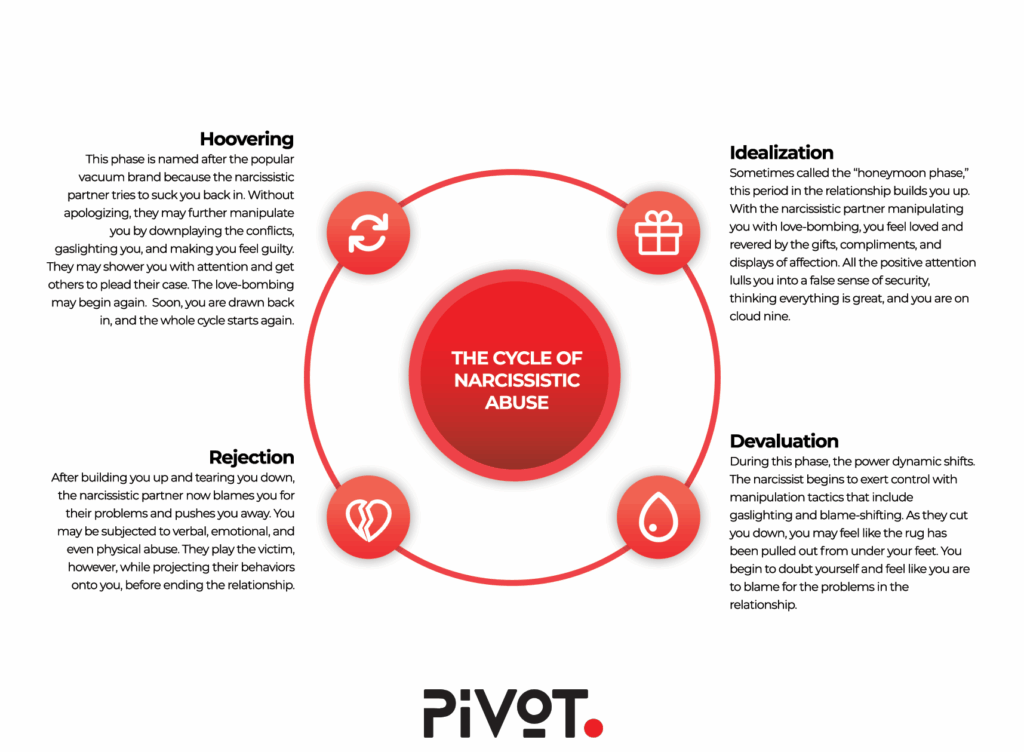
The narcissistic abuse cycle follows a painful pattern of idealization, devaluation, rejection, and hoovering. We’ll dive deeper into these stages later. At PIVOT, our support system empowers you to break free from this toxic cycle and rebuild confidence for healthy, fulfilling relationships.

How to Break the Cycle of Narcissistic Abuse for Good

Action You Must Take

How PIVOT Supports You

Validate your feelings

One of the most challenging consequences of narcissistic abuse is the self-doubt that permeates your thinking and decision-making capacity. Likely the result of gaslighting and other manipulative tactics, it undercuts your self-confidence and limits your resolve for change. Your PIVOT coach will help you to trust yourself and believe that change is possible.

Gain compassion for yourself

The emotional abuse of a narcissistic partner can make you feel really bad about yourself. You may have been putting your needs aside to keep the peace and please your partner. The PIVOT Process helps you develop compassion for yourself and prioritize your needs.

Recognize manipulation tactics

Many narcissistic manipulations are difficult to recognize. You may not realize you have fallen prey to them until it is too late. Learning to recognize these manipulative tactics can help you avoid the emotional pain they inflict.

Learn to set and hold boundaries

A lack of boundaries can make you a target of narcissistic abuse. Your PIVOT coach will help you learn to set and hold protective boundaries to guard against future abuse.

Articulate your feelings and desires

Breaking the abuse cycle once and for all means putting yourself first. The PIVOT Process helps you to get in touch with why you have fallen prey in the past and gives you tools to ensure you are not marginalized in the future. You will learn to express yourself and take charge of your life.

Part of breaking free of narcissistic abuse is understanding the patterns it often takes. Part of the PIVOT process is education on the cycle of narcissistic abuse, so you can identify it early on and avoid falling into the same toxic patterns over and over again.

Understanding the Cycle of Narcissistic Abuse

the cycle of narcissistic abuse - hoovering, idealization, rejection, and devaluation.

The cycle of narcissistic abuse is characterized by emotional abuse and manipulation tactics, often referred to as the narcissistic abuse cycle, particularly in relationships involving individuals with narcissistic personality disorder. Narcissistic behaviors, such as gaslighting and devaluation, contribute significantly to this cycle, making it difficult for victims to recognize and escape the manipulation. This abuse doesn’t just happen in romantic relationships—you can experience it with friends, siblings, and even parents. Narcissistic behavior often involves manipulative tactics that follow a predictable cycle, making it vital to recognize these patterns. By identifying such behaviors, you can take the necessary steps to break free from toxic dynamics and prioritize your mental health.

Narcissists are often drawn to specific vulnerabilities in a partner. Those who have experienced childhood trauma or abuse or had a narcissistic parent may be particularly susceptible. Partners who are lonely, lack confidence, or have low self-esteem may also fall prey to narcissistic abuse.  Likewise, people who are ill and need help or suffering from emotional or financial hardships are also especially vulnerable to narcissistic manipulation. That isn’t to say that it is your fault – anyone can fall into a narcissistic dynamic. That’s why it is so important to know the signs.

Understanding the cycle of narcissistic abuse can be a profound moment of enlightenment. It’s like finally seeing the light at the end of a long, dark tunnel. This understanding empowers you to take control of your life and break free from the toxic cycle. Narcissistic manipulation can distort your sense of reality, making it crucial to trust your perceptions and seek support.

Leaving a narcissistic relationship can be incredibly challenging for you, and it requires careful planning. Recognizing narcissistic traits in your partner is the first step towards protecting yourself and seeking the help you need.

Curious How You are Attaching in a Specific Relationship?

[template_part_attachment_quiz]

How to break the cycle of narcissistic abuse with empathetic support at a retreat

Take Your Life Back With PIVOT

If you are reading this and it feels all too familiar, we can support you. We’ve helped hundreds of people as they break free from toxic relationship dynamics and build healthier, happier connections free of abuse. Let PIVOT show you how to break the cycle of narcissistic abuse by fostering self-awareness. Start living on your terms with us by your side. Reach out or call 1-855-452-0707 to begin the journey.

pivot company logo with tagline