Build Confidence at a Retreat for Narcissistic Abuse

You have taken that brave first step: you have finally recognized the manipulationgaslighting, and love-bombing for what it is – narcissistic abuse. You have declared to yourself that enough is enough. Now what?

If you have decided to end the abuse that has kept your relationship in a continuous cycle of emotional pain, you may need help to break free once and for all. A retreat for narcissistic abuse may be just what you need to transform your world and secure your future, providing a sense of relief and empowerment.

A Retreat for Narcissistic Abuse Accelerates the Healing

Depending on the amount of time spent in this relationship, you may have developed symptoms of codependency that have left you feeling trapped. Narcissistic abuse may have also cost you other key relationships, leaving you feeling broken and alone. In any case, the trauma has no doubt damaged your psyche, self-image, and decision-making ability. You’ll need help and support building back your confidence and independence.

Our retreats for narcissistic abuse help you take that brave next step in the direction of freedom and joy. Here are some of the ways we can support you along the healing pathway.

7 Ways a Retreat for Narcissistic Abuse Accelerates the Healing

Needed for Recovery

How a Retreat Speeds the Healing

Rehabilitate your self-image

As a victim of narcissistic abuse, your self-image has likely taken a beating. The retreat’s healing focus helps you view yourself as a survivor who is worthy and capable of healthy relationships.

Restore your confidence

You will need confidence to persevere and manage your recovery pathway. The support of a retreat can build back your confidence and help you realize you are strong enough to handle the journey ahead.

Promote trust in your decisions

As you begin to understand narcissistic abuse and its impact on your sense of self, you will learn to trust your decision-making ability again. This is essential for moving forward as an independent and capable individual.

Create a support system

When you attend a retreat for narcissistic abuse, you and your coach have the opportunity to get deeply acquainted. You also build camaraderie with your fellow participants based on shared experiences. These individuals become part of a caring and empathetic support system, cheering you on as you reclaim your life and making you feel less alone and more supported.

Improve communication capacity

While learning to trust your inner voice again, you will gain communication strategies to help you express yourself effectively.

Learn to set and maintain boundaries

As you learn to recognize manipulative tactics, you will be empowered to set and maintain healthy boundaries that protect you and your interests.

Make a plan for the future

With an emphasis on self-care and a toolbox of actionable strategies, you will be on your way to building the happy, healthy relationships you desire in the future.

A PIVOT Retreat Helps You Heal Quickly

When you’re ready to break free from the cycle of narcissistic abuse, time is of the essence. You want to start feeling better as soon as possible, and a PIVOT retreat is the fastest way to kickstart your healing journey.

Set in the picturesque hills of Northern California, The Glass House provides a tranquil escape from the chaos of everyday life. Here, PIVOT hosts our intimate retreats for narcissistic abuse, each limited to six guests who are all on a journey to break free from the effects of emotional abuse.

Our guests spend five days in this safe and supportive space, quieting their minds with yoga and meditation. Locally sourced, healthy meals and comfortable accommodations support you as you work through individual and group sessions. This immersive format allows you to accelerate the healing and strengthen your sense of self. If you wish to continue the work after your retreat concludes, our coaching for narcissistic abuse provides ongoing support.

A retreat for narcissistic abuse provides a support system

What You Can Expect From the PIVOT Process

Our highly effective PIVOT Process focuses on helping you find your strength. Our clients are always impressed with how much they get from our program and how quickly they feel they are progressing.

If you wish to break the cycle of emotional turmoil and are determined to start healing quickly, a PIVOT retreat for narcissistic abuse at The Glass House provides the optimal chance for decisively regaining control of your life. The PIVOT Process helps clients understand their attachment styles and work towards building secure attachments to create healthier relationships in the future.

Accelerate the Transformation With PIVOT

PIVOT offers high-impact solutions to painful relationship challenges at our retreat for narcissistic abuse. Contact us to begin the healing journey today. You can reach us at 1-855-452-0707.

How to Break the Cycle of Narcissistic Abuse Once and For All

The cycle of narcissistic abuse is characterized by ups and downs. When times are good, they may seem too good to be true. Unfortunately, the bad times take a toll. By the time you recognize the toxic nature of this roller-coaster relationship, there may be significant damage to your sense of self. You may feel broken, hopeless, and lost.

Know this: you aren’t alone. PIVOT is your dedicated support system, standing by your side. We can help you build back your trust in yourself and your sense of hope. Let us help you learn how to finally break free from the cycle of narcissistic abuse. Our relationship coaches are uniquely positioned to help you break this toxic pattern once and for all. If you have had enough emotional abuse from a relationship with a narcissistic partner and are ready to stand up for yourself, let us help you take your life back.

How to Break the Cycle of Narcissistic Abuse and Get a Fresh Start with Self Love

To break the cycle of narcissistic abuse once and for all, the change has to come from you. Helping you to accomplish this transformation is where PIVOT excels. At our intensive retreat for narcissistic abuse, we provide a safe space to support individuals who desire a different path for their life. Through our exemplary process, we will help you to recognize and heal the childhood traumas, insecurities, and pains that weigh you down. As you practice self-care and regain your sense of self, you will learn step-by-step strategies for resolving conflict, improving communication, and holding protective boundaries. When you work through our proven process, you will be ready to approach relationships as a strong, resilient individual who is worthy and capable of secure attachment and healthy, reciprocal relationships.

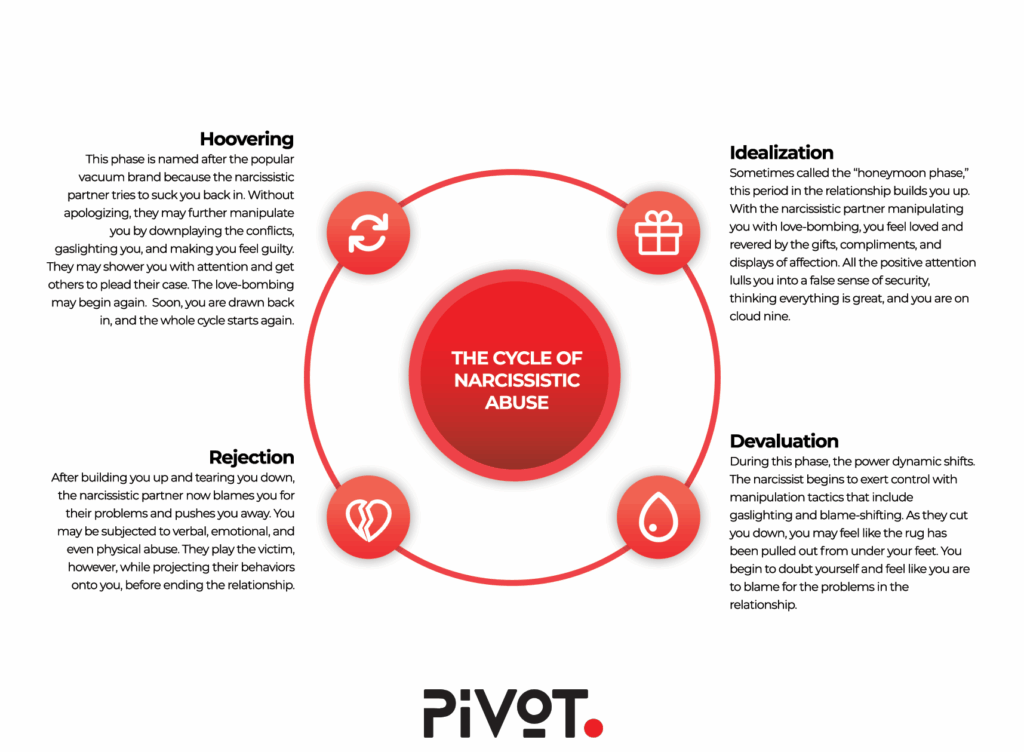
The narcissistic abuse cycle follows a painful pattern of idealization, devaluation, rejection, and hoovering. We’ll dive deeper into these stages later. At PIVOT, our support system empowers you to break free from this toxic cycle and rebuild confidence for healthy, fulfilling relationships.

How to Break the Cycle of Narcissistic Abuse for Good

Action You Must Take

How PIVOT Supports You

Validate your feelings

One of the most challenging consequences of narcissistic abuse is the self-doubt that permeates your thinking and decision-making capacity. Likely the result of gaslighting and other manipulative tactics, it undercuts your self-confidence and limits your resolve for change. Your PIVOT coach will help you to trust yourself and believe that change is possible.

Gain compassion for yourself

The emotional abuse of a narcissistic partner can make you feel really bad about yourself. You may have been putting your needs aside to keep the peace and please your partner. The PIVOT Process helps you develop compassion for yourself and prioritize your needs.

Recognize manipulation tactics

Many narcissistic manipulations are difficult to recognize. You may not realize you have fallen prey to them until it is too late. Learning to recognize these manipulative tactics can help you avoid the emotional pain they inflict.

Learn to set and hold boundaries

A lack of boundaries can make you a target of narcissistic abuse. Your PIVOT coach will help you learn to set and hold protective boundaries to guard against future abuse.

Articulate your feelings and desires

Breaking the abuse cycle once and for all means putting yourself first. The PIVOT Process helps you to get in touch with why you have fallen prey in the past and gives you tools to ensure you are not marginalized in the future. You will learn to express yourself and take charge of your life.

Part of breaking free of narcissistic abuse is understanding the patterns it often takes. Part of the PIVOT process is education on the cycle of narcissistic abuse, so you can identify it early on and avoid falling into the same toxic patterns over and over again.

Understanding the Cycle of Narcissistic Abuse

the cycle of narcissistic abuse - hoovering, idealization, rejection, and devaluation.

The cycle of narcissistic abuse is characterized by emotional abuse and manipulation tactics, often referred to as the narcissistic abuse cycle, particularly in relationships involving individuals with narcissistic personality disorder. Narcissistic behaviors, such as gaslighting and devaluation, contribute significantly to this cycle, making it difficult for victims to recognize and escape the manipulation. This abuse doesn’t just happen in romantic relationships—you can experience it with friends, siblings, and even parents. Narcissistic behavior often involves manipulative tactics that follow a predictable cycle, making it vital to recognize these patterns. By identifying such behaviors, you can take the necessary steps to break free from toxic dynamics and prioritize your mental health.

Narcissists are often drawn to specific vulnerabilities in a partner. Those who have experienced childhood trauma or abuse or had a narcissistic parent may be particularly susceptible. Partners who are lonely, lack confidence, or have low self-esteem may also fall prey to narcissistic abuse.  Likewise, people who are ill and need help or suffering from emotional or financial hardships are also especially vulnerable to narcissistic manipulation. That isn’t to say that it is your fault – anyone can fall into a narcissistic dynamic. That’s why it is so important to know the signs.

Understanding the cycle of narcissistic abuse can be a profound moment of enlightenment. It’s like finally seeing the light at the end of a long, dark tunnel. This understanding empowers you to take control of your life and break free from the toxic cycle. Narcissistic manipulation can distort your sense of reality, making it crucial to trust your perceptions and seek support.

Leaving a narcissistic relationship can be incredibly challenging for you, and it requires careful planning. Recognizing narcissistic traits in your partner is the first step towards protecting yourself and seeking the help you need.

Curious How You are Attaching in a Specific Relationship?

[template_part_attachment_quiz]

How to break the cycle of narcissistic abuse with empathetic support at a retreat

Take Your Life Back With PIVOT

If you are reading this and it feels all too familiar, we can support you. We’ve helped hundreds of people as they break free from toxic relationship dynamics and build healthier, happier connections free of abuse. Let PIVOT show you how to break the cycle of narcissistic abuse by fostering self-awareness. Start living on your terms with us by your side. Reach out or call 1-855-452-0707 to begin the journey.

pivot company logo with tagline

Can a Relationship Work After Cheating

As much as you want to believe that your relationship can recover after infidelity and that putting time and effort into its recovery will be worth your while, here’s where it gets tricky: infidelity makes things messy and complicated. It leaves the partner who was cheated on with the bitter aftertaste of disappointment and the partner who cheated with the feelings of guilt  – intensified while the other partner is trying to get to a place of forgiveness.

If one of you was unfaithful, yet both of you are now willing to make it work, what can you do to initiate the healing process and rebuild a healthy relationship? If you agree that your relationship is worth saving, can it survive and last? You may wonder if it’s even possible: “Can a relationship work after cheating?”

Dealing With Infidelity and the Aftermath

If you and your partner are navigating the aftermath of infidelity, being in the same room or attempting meaningful communication might feel impossible. However, understanding what led to the betrayal is the only way to heal and rebuild trust. Infidelity often stems from deeper emotional, relational, or personal problems, and addressing these issues will give you a strong foundation to move forward together. Seeking the guidance of a professional relationship coach or attending a private couple’s retreat can provide a safe space for you to unpack these challenges and work toward reconnection.

Key Steps in Dealing With the Aftermath of Infidelity

Creating Safe Spaces

Establish non-judgmental environments to discuss emotions and needs.

Identifying Underlying Causes

Explore what contributed to the infidelity, such as unmet needs or communication gaps.

Rebuilding Trust

Develop consistent, honest communication and transparency to rebuild faith in one another.

Seeking Professional Help

Work with an expert relationship coach to facilitate difficult conversations and mediate healing.

Strengthening the Relationship

Set goals, practice vulnerability, and rediscover your shared values and unique connections.

A PIVOT couples retreat is a profound experience designed to help you and your partner work through the challenges of infidelity in a supportive and nurturing setting. These retreats allow you to disconnect from everyday distractions and focus entirely on your partner and relationship. Guided by our expert coaches, you’ll delve into the root causes of betrayal, explore your attachment styles, and learn practical tools you can implement during the retreat and beyond to build a healthier, more secure bond.

Benefits of attending a couples retreat include:

  • Time to process and understand your WHY?
  • Take an honest look at the possibility of reconciliation or consciously uncoupling.
  • Get appropriate tools and boundaries to deal with the aftermath of betrayal.

Through targeted exercises, honest communication, and the guidance of our skilled facilitators, PIVOT couples retreats empower you to rebuild your fractured relationship with empathy, understanding, and lasting solutions to move forward.

Once A Cheater Always A Cheater: Is It True? 

Sad Girl Private Couple Retreats for Reconnection

If you fear that a partner who cheated once will do it again, you’ll have to get honest with yourself: yes, it could be true. But it’s far from a universal truth. The damage is done, but if both partners are equally willing to make it work, there is hope yet. This depends mainly on whether partners can regain and rebuild mutual trust and make room for reconnection, understanding, and forgiveness. 

Distrust is toxic, destructive, and breeds dysfunction.  Initially, there will be distrust – it’s expected in the fallout of such a betrayal, and it will take time to earn that trust back. However, continued mistrust toward the partner could doom a relationship that might be worth saving. Regardless of whether it was you or your partner who cheated, the situation will be beyond help if there is continued distrust between the two of you over a long period of time.

Can A Relationship Work After Cheating, Can You Move Past It?

First and foremost, you have to give yourself time, regardless of whether it was you or your partner who cheated. Couples can and do overcome and bounce back after infidelity, sometimes with renewed passion.

But moving past cheating and staying together with a cheating partner is possible only if you meet the main criterion: look at the relationship through a lens of reality, including what you may need to change. betrayal is not excusable; however, make an honest attempt to understand how it happened. It takes time to let go of the resentment toward the partner who cheated; however, if you don’t over an appropriate amount of time, the relationship will not be repaired.

To make matters worse, unresolved anger and resentment could have a detrimental effect on you as a person and render you incapable of truly moving on. Having unresolved issues because you were cheated on can have a lasting impact on your emotional and romantic life. Even if you decide to end the relationship in which you were cheated on, the frustration you have failed to deal with could spill over and impact your future relationships. Provided that both of you are willing to go all out and capable of mustering the strength to salvage the relationship, can you do it on your own, or should you seek professional help and guidance? Together with your partner, you can try a relationship-building skills workshop or, better yet, a private couple’s retreat for reconnection. If you think you could use some alone time to try and overcome issues of your own, perhaps you should try working alongside an individual coaching expert beforehand.

How Often Do Couples Stay Together After Infidelity?

Cheating appears to be common among both men and women, even in what are supposed to be loving, committed relationships. How often is it a deal breaker? The statistics appear grim.

According to some estimates, few couples who have experienced infidelity can rework their relationship by themselves and make it last. Almost half of the couples decide to end the relationship immediately after the truth comes out, and a third decides to try to make it work, but they eventually break up. This is primarily because the couple did not get help initially.  

Most people are caught off guard by their partner’s infidelity. Whether because they fail to recognize issues in their relationship or because they trust their partner without reservation, they never see it coming. Whether or not they can overcome and truly recover from infidelity could depend on the circumstances under which infidelity took place:

  • The partner’s willingness to discuss the affair openly
  • The details of the affair
  • The level of emotional intimacy between partners

Can A Relationship Go Back To Normal After Cheating?

If attempts at reconciliation and recovery are one-sided, it’s pointless even to try to patch things up. If you and your partners are committed to making it work and bringing the romance back to life, challenging times lie ahead. However, it can become healthy again. In some cases, relationships can actually become BETTER than ever. 

It’s extremely difficult for a couple to go back to normal and rebuild trust in their relationship after infidelity because trust violation is inevitable. The partner who was cheated on is likely to have major trust issues, and so will the partner who cheated. Keep in mind that people who cheat on a regular basis are often jealous and suspicious of their partners because they project their own negative emotions and desires onto others. Chances are you both could use some time to think things through and possibly some alone time. You can consider taking a break from your relationship and then start over if you both feel it is the right thing to do. Some couples choose to attend a couples retreat as part of the healing process.

Steps To Rebuilding A Relationship After An Affair

Mutual commitment to investing time, energy, and emotional work into resolution

Renegotiating the terms of the relationship

Commit to understanding why the betrayal happened and be accountable for the actions.

Open communication between partners so they can begin to get a plan in place of how to move forward to build trust again if the intention is to stay together as a couple.

And then with the help of a professional to move forward based on the information that was uncovered and worked through during the healing time

Bounce Back With Healthy Relationship Workshop Activities!

Sad Couple Healthy Relationship Workshop Activities

Smoothing things over with your partner and rebuilding a strong and healthy relationship is hard work, especially after infidelity or adultery. Regardless of which partner had the affair, you need to join hands and work toward recovery. It’s time to lean in to deeper understanding, and we are here to give you our support and professional guidance through our relationship workshops. Some couples find that they can make the most progress with individual coaching sessions, and others prefer to take our customized intensive workshops. The PIVOT process could be the answer you have been looking for. Call now!

Transform Your Relationships With PIVOT  

PIVOT offers expert relationship coaching for couples navigating the aftermath of infidelity. If you’re wondering, “Can a relationship work after cheating?” our experienced coaches are here to guide you. Reach out to begin your journey to a healthier, happier life. You can reach us at 1-855-452-0707

Signs You’re Not Ready to Date After a Breakup

After a breakup, the silence can feel deafening. You might find yourself staring at your phone, tempted to swipe right on a dating app, thinking a new relationship will fill the void. But deep down, you might wonder: Am I really ready to start dating again? The truth is, the pull to move on quickly can be strong, especially when loneliness creeps in. Yet, rushing into something new can sometimes lead to more heartache than healing. Imagine going on a date, but instead of enjoying the moment, you’re haunted by thoughts of your ex—comparing your date to them or feeling a pang of guilt for not being fully present. It’s a common pitfall, and one that highlights why it’s so important to pause and reflect on your readiness.

The answer isn’t simple, and there’s no one-size-fits-all timeline. Just as every breakup is unique, so is the journey to healing. At PIVOT, we believe that everyone’s path is different. Some might find clarity through a relationship coaching retreat for singles, where they can focus on self-discovery and emotional readiness. Others might prefer the personalized guidance of one-on-one sessions with a relationship coach. What matters most is taking the time to understand your own heart before opening it to someone new.

How Do You Know You’re Not Ready To Date?

Couple Night Relationship Coaching Retreat Singles

Some people start dating within days of ending their previous relationship. Others are lonely but not ready to date and feel like they need to spend the same amount of time being single as they were in their last relationship.

However, if dating seems too hard now, or you feel anxious at the thought of sitting opposite a stranger and talking about yourself… then you may not be ready to date right now.

The good news is that it’s not permanent. It means you may need to take time to heal first.

How Soon Is Too Soon After A Breakup?

If you’re wondering if you are ready or not to date, here are 8 signs you’re not ready to date:

1) You’re Not Over Your Ex

If the pain from breaking up with your ex is still fresh and raw, then perhaps you haven’t healed from your past relationship.

Ask yourself…

  • Does seeing your ex with someone new make you jealous, sad or angry?
  • Do you keep in touch regularly?
  • Do you talk about your ex in general conversation?
  • Do you compare others with your ex?

If you said “yes” to at least two of these questions, then you may not be ready to let someone new into your life.

It’s important to let go of the past relationship before you commit to someone else.

2) You Keep Making The Same Dating Mistakes

Some people have unhealthy dating patterns. They seem to date the same type of person, choose an unavailable partner, or they attract people who bring out their worst.

These unhealthy dating choices are typically based on past experiences… a reaction to our parents’ relationship or our own relationship experience.

In either case, a negative relationship experience can have a deep impact on our capacity for healthy relationships.

If this has happened to you, then the best way to move forward is to seek professional help, so you understand what your typical attachment style is and how to choose to date someone who is more compatible.

3) You Change Yourself To Be What You Think The Other Person Wants

One signal that you’re not ready to date is that you feel like you need to change yourself to be what the other person wants. If you don’t cook – don’t say you do! You will find yourself panicking at the first invitation for them to come to your house for dinner!

If this is the case, take time to reflect on what’s important to you, what your values are and what makes you special. Appreciate your positive qualities.

If you do feel like you need to change for the other person, then this might be a sign that your old relationship gave you insecurities about who you are or your self-worth. Remember, it’s important to bring yourself to a relationship, not lose yourself in it.

Take time to reconnect to yourself, determine your values and find out what you like and don’t like.

Most of all, love yourself for the special, and unique person that you are.

4) You’re Looking For Someone To Complete You

If you believe that a relationship is going to fill your “emptiness,” then you’re not ready to be in a relationship or start dating yet.

You may be looking for someone to fill a role in your life… rather than looking to share your life with someone.

You first need to feel whole and confident as a single person before being ready to share your life with another person. If you have untreated attachment wounds, it is hard to find healthy self-esteem to bring to the dating process.

The best relationship you need to have is with yourself.

Start by validating your own existence, instead of counting on someone else to do that for you. And remind yourself that a relationship doesn’t define you.

Focus on becoming the best version of yourself first. Once you feel whole, then you can invite someone to share your life.

5) You Are Working On Yourself Right Now

If you feel like you have some work to do on yourself, then you may still have unresolved issues or pain in your life.

And that’s ok.

You need to be ready to let someone else into your life.

After all, it’s not possible to be available for others if you haven’t taken care of yourself first.

The key is to work through your pain, don’t ignore it; otherwise, you’ll be emotionally vacant.

It’s crucial to feel happy, balanced and healed.

If you’re not happy with yourself, your job, your health or your life in general, then you need to own and get straight with your challenges first. Being single and facilitating a relationship is hard work, especially if you haven’t yet become the person you want to be, and an intensive workshop or one-on-one coaching may be exactly what you need.

6) You Have Trust Issues

Trust takes time. Not being able to fully trust someone over time that you let into your life is a sign you’re not ready to date.

Although you may want love and to be loved, lacking trust in your relationship from the past will make it difficult for you to emotionally attach to someone because you don’t want to get hurt.

Trust issues come from past hurts that may have occurred in previous romantic relationships or from unhealthy family relationships during childhood. Or both.

Many people with trust issues know they have trouble in their relationships, but don’t realize it comes from a trust problem.

Before you are ready to date, you will need to work through your trust issues and heal from past hurts.

7) You Want Someone To “Save” You

A healthy relationship is not about saving each other. It’s about giving and sharing.

If you feel like you need someone to “save” you, then you need to look deeper at the real issues.

First, you need to fix yourself, find out what makes you happy, think about what needs to change.

When you know you have something to give and share with others, then you know you’re ready to start dating seriously.

If you say to yourself:

  • I’m such a mess. I need help.
  • Why am I so insecure?
  • Am I good enough for a relationship?

…then you need to heal these issues first before you are ready to start dating.

If you don’t do this, then you’ll attract a partner that wants to “save” people, or someone with the same issues.

And, the wounded cycle repeats itself…

8) You Feel Emotionally Drained

A healthy relationship thrives on emotional energy—connecting, communicating, and building something new together. You could be too exhausted to care, snapping for no reason, or shutting down when someone tries to get close. This weariness is a big red flag that you’re not ready to date.

If you’re wondering:

  • Why do I feel so tired all the time?
  • Can I even handle a relationship right now?
  • What’s sucking the life out of me, and how do I fix it?

…then it’s time to step back. Emotional drain often links to unresolved baggage—like an ex you’re not over or trust you can’t rebuild yet. Jumping into dating now could mean missteps, mixed signals, or pulling in someone who’s just as checked out as you are.

Instead, recharge yourself first. Lean into self-care—rest, hobbies, or good company. Draw some lines to guard your energy. When you feel full again, you’ll date with a clear head and an open heart.

How Do You Know When You’re Ready To Date Again?

To help you determine when you may be ready to date again, ask yourself these questions:

  1. Do I think that I’ll eventually find the person I want?
  2. Do I believe that I’m a worthwhile partner?
  3. Do I trust that I’ll have a great new relationship in the future?
  4. Do I think that I’m over the pain from my past relationships?
  5. Do I think of the good things I did in my past relationship?
  6. Do I believe my previous partner did care for me?
  7. Do I believe I’ve learned what I need to know to try dating again?
  8. Do I feel confident knowing what to do differently next time?
  9. Do I know without a doubt that I will respectfully get out of a relationship that is unhealthy for me sooner rather than later?
  10. Do I believe that things work out the way they’re supposed to?

If you answered yes to at least seven of the questions, then you may be ready to date again.

How Do I Go Back To Dating After Years Of Being Single?

Getting back into the dating scene after a lengthy break can be a scary experience. If you’ve spent a long time by yourself, you may be uncertain about meeting new people and sharing vulnerable parts of yourself with someone else. Whether you’re going back to online dating or trying to find someone in your friend circle, we have some tips that might make putting yourself out there easier:

  • Don’t take dating too seriously: even if you are looking for a long-term relationship, try to have fun while dating. Don’t be hesitant to flirt and explore your options on dating apps. It may help you regain confidence and prepare you for the right thing when it comes.
  • Go out with your friends: your chances of meeting someone worthy will be very slim if you never leave your house. Hit up your friends and enjoy a fun night out instead. You may just meet someone that sparks your interest.
  • Ask around: there’s a perfectly good chance that your friends know someone that you may like. Going on a date or two can’t hurt, and if your friends know you well, they should be able to find a potential match for you.
  • Take it slow: if you haven’t dated for a while after a bad breakup or divorce, your self-esteem may not be in the best shape. Make sure not to rush yourself into a new relationship and give yourself time to think about what you really want.
  • Consult professionals: contacting a relationship coach or attending a relationship coaching retreat for singles may help you understand yourself and your needs better and in turn make the entire dating process far more enjoyable.

How To Tell Someone You’re Not Ready For A Relationship?

Recognizing that you are not yet ready for a relationship takes maturity. If you are aware that you still have some unresolved issues that you need to tackle, then you should make that clear to any potential partners you may encounter.

If you’ve met someone and want to let them know that you’re not prepared to commit, here’s how you can do so nicely:

  • Be honest and open
  • Ask them what their idea of a relationship is
  • Check if they are willing to take things slow
  • Compromise if possible
  • Don’t sugarcoat and give them false hope

The most important thing here is that you don’t let anyone pressure you into a relationship if you’re not 100% certain that you are ready. If you need support while navigating the dating world and understanding your own needs, consider seeking out a relationship coaching retreat for individuals and you may just find the strength and stability you need before getting into another relationship.

Ready to Heal and Date Again? Let PIVOT Guide You

Couple Kiss Relationship Coaching Retreat Individuals

You’ve taken the first step by recognizing the signs—you’re not alone in feeling unsure about dating after a breakup or a tough emotional chapter. Now, it’s time to turn that awareness into action. At PIVOT, we’re here to help you heal from past hurts, rebuild your confidence, and step into the dating world with clarity and purpose. Our personalized coaching sessions and immersive five-day retreats are tailored to give you the tools and insights you need to create healthy, fulfilling relationships.

Imagine dating with confidence, knowing exactly what you want and need in a partner. With PIVOT, you’ll discover how to:

  • Break free from unhealthy patterns that keep you stuck.
  • Heal emotional wounds holding you back from love.
  • Attract the right partners who align with your values and goals.

For a limited time, we’re offering a free 30-minute consultation to explore your unique situation and see how PIVOT can support your journey. Don’t wait—spots are filling up fast, and this is your chance to start building the love life you deserve. Take the first step today and contact PIVOT to schedule your free consultation. Our personalized individual coaching sessions and intensive five-day retreats help you identify what you want and need in relationship with others. Your healthier, happier relationships are closer than you think!


Codependency and Narcissism Relationships: Untangling the Web

Codependents and narcissists seem to be a match made in heaven…or hell. Inexplicably drawn to each other, their relationship resembles a tangled web, intertwined but fragile. Though the codependent partner attempts to exert control by meeting the other’s needs, the narcissistic partner is also controlling, selfish, and egotistical. 

While we are not big on labels, people who come to PIVOT seeking help in their relationships often use these descriptions to characterize their partners. Although the labels may not be entirely accurate, there is usually a deeper truth to uncover. If you need help untangling the web of a codependency and narcissism relationship, PIVOT is here to help.

Understanding Codependency and Narcissism Relationships

Understanding the complex dynamics of codependency and narcissism can bring a sense of relief and hope. By appreciating the typical character traits of both partners, we can begin to untangle the web of this complex relationship. Despite the challenges, there is always a path to healing and healthier future relationships.

It is not clear whether their similarities or their differences draw them together, but the pairing of codependent and narcissistic partners is inherently unstable. Both exhibit a series of codependent characteristics that lead to intimacy issues in their relationships. While a codependent partner may be subject to narcissistic abuse, typically, both partners are suffering in this dysfunctional relationship.

Healing for Codependency and Narcissism Relationships

At PIVOT, we understand that adult relationship issues often stem from childhood trauma and early attachment wounds. Our process involves revisiting your past and changing your relationship with it to pave the way for healthier future relationships.

As humans, everyone is capable of giving and receiving love. However, some of us need help sorting out our baggage before we can untangle the web of a dysfunctional relationship. PIVOT coaches can help you do just that. By replacing unhealthy coping mechanisms and survival patterns, you can make room for healthier behavior more conducive to fulfilling, reciprocal relationships

Seeking Help for Codependency

If you see yourself in the role of a codependent partner, we are here to help you PIVOT away from the same ineffective behavior patterns that have you stuck in this painful relationship. Once you have the desire and motivation to change, we will meet you where you are and help you to forge a different path forward.

Our relationship coaches have expertise in untangling the intricate dynamics of interpersonal relationships. Even the complexities of the codependency and narcissism relationship are no match for our research-based process.

Your PIVOT coach will help you to:

  • Gain confidence in yourself
  • Connect with your own wants and needs
  • Set and maintain healthy boundaries
  • Make decisions that benefit you
  • Learn to communicate more effectively

If you are in a codependent relationship and want to make a positive change in your life, remember that you are not alone. PIVOT is here for you.

Creating Lasting Change for Narcissistic Behaviors

If you recognize any of the narcissistic traits in yourself, it’s important to remember that you have the power to change. These traits may prevent you from having healthy, fulfilling adult relationships, but with support, you can replace these ineffective and troubling behaviors with healthy actions. By learning new strategies for making solid and supportive attachments, you can take control of your relationships and your life.

Your PIVOT coach will:

  • Help you develop a realistic self-image 
  • Encourage empathy for others
  • Help you establish your recovery goals
  • Provide sequential assignments for taking positive action
  • Be available between sessions via text, phone, or email

If you find yourself guilty of narcissistic behavior in your closest relationships, it’s important to remember that healing is possible. The PIVOT Process empowers you to make lasting behavioral changes. By acknowledging your behavior and committing to change, you can take the first step towards a healthier, more fulfilling future.

FAQs

1. Can a codependent partner also be narcissistic?

The answer to this question is not clear-cut; narcissism and codependency often overlap. One wants to feel important, while the other wants to feel needed. Their core shared characteristic is they depend on others for validation. 

A narcissist may use abusive tactics, such as projection, to manipulate their codependent partner into believing they are, in fact, narcissistic. However, it is also possible that a codependent partner displays narcissistic tendencies at times as a result of childhood trauma, making it quite challenging to decide whether they are codependent, narcissistic, or both.

2. What happens when you leave a narcissistic partner?

Deciding to take control of your life and free yourself from narcissistic abuse is a brave move, but true healing takes time. Allow yourself some grace as you make this transition. Practice self-care and identify a support network. A PIVOT relationship coach has the expertise to advise and support you as you break this painful cycle and find your inner strength.

3. How can I get the healing started?

Get a decisive start on the pathway to healing by reaching out to a relationship coach specializing in complex relational dynamics. Our coaches are all certified in the PIVOT process. They have diverse backgrounds in therapy and other coaching models. When you contact PIVOT, you will be carefully matched with the best possible coach based on your specific needs and personality.

4. What is special about the PIVOT process?

The PIVOT process starts with your own life story. As you work through it, you create a living document, a toolkit, to support you as you approach future relationships.  This universal process is used in every PIVOT program, whether weekly coaching, intensive, or retreats.   Our clients are always impressed with how much they get from our program and how quickly they experience change.

5. What is the format of the sessions?

When working with PIVOT, you will meet with your relationship coach virtually, by phone,  or in person, according to your preference. Your coach is also available between sessions by text and email — which is a game changer if you are struggling with relational changes. You will receive the curriculum for each session to study and apply to your life. You can also hire your coach for a Personalized PIVOT: a one- or two-day intensive session that you can do in person at The Glass House or from the comfort of your home!

6. What should I expect at a Narcissistic Retreat?

PIVOT offers two types of Narcissistic Retreats: one for partners with narcissistic tendencies and a separate retreat for partners who have suffered narcissistic abuse. Both take place at The Glass House in Northern California. Groups are limited to 6 gender-specific clients, and the program offers yoga, meditation, healthy meals, and personal and group meetings.
We focus on high-impact solutions to this challenging relationship dynamic. Whether you’re working through replacing unhealthy coping mechanisms or letting go of codependency, we will help you identify your needs, set and maintain boundaries, and prepare to cultivate healthier relationships in the future.
Learn more about our retreats here.

Transform Your Relationships With PIVOT

PIVOT coaches have the expertise required to untangle codependency and narcissism relationships. We will work with each partner individually to facilitate lasting behavioral change. Contact us today if you are ready to break the painful cycle and experience true relational freedom. You can reach us at 1-855-452-0707

Narcissistic Love Bombing Cycle: All You Need To Know

Lavish affection and adoration are probably not the first thing that comes to mind when you think about narcissistic abuse. You are more likely to remember some of the more frequently talked about manipulation tactics such as gaslighting, playing the victim, humiliation, and other power and control mind games.  

But did you know that one of the favorite narcissistic weapons involves the use of overwhelming flattery and attention? This is known as a narcissistic love bombing cycle, an incredibly effective form of manipulation that pulls you in with promises of exhilarating romance and spits you out feeling dazed, confused, and betrayed

If you’ve been the victim of narcissistic abuse, know that you are not alone. You can find the resources and support you need in one of the many Glass House retreats designed for individuals dealing with anxiety in romantic relationships and other emotional struggles.

What Is Love Bombing In Dating?

As the name suggests, love bombing entails overwhelming someone, or rather “bombing” them with excessive signs of affection and attraction. This may include a combination of leaving love notes, flattering comments, sending flowers, and many other tokens of affection. The narcissist will shower you with romantic gestures, increasing their intensity and frequency until you feel like you’re on top of the world and ready to relinquish all sense of control to them and nobody else.

The Root Cause of Love Bombing: Narcissistic Supply

What Is The Purpose Of Love Bombing?

Individuals who employ love bombing techniques tend to suffer from a lack of confidence and a deep feeling of insecurity. Their low self-esteem pushes them to seek constant validation and reassurance, known as narcissistic supply. Unfortunately, nothing is ever enough to satisfy their need for approval and fill the void inside of them. 

Behind their air of confidence and importance, love bombers feel deep down that they are unlovable, undesirable, and unworthy. In order to feel valuable, they resort to a narcissistic love bombing cycle with the aim of giving their ego a much-needed boost and fulfilling their needs for power and control. 

What Is The Purpose Of Love Bombing?

Being showered with affection can be highly intoxicating. The overwhelming positive attention hijacks your dopamine systems, keeping you focused on the source of the love bomb, wanting more. The love bomber will keep you tethered, giving you a taste of what’s to come and then pulling back. This will make you vulnerable to their wide arsenal of manipulation tactics as long as you continue meeting their narcissistic supply needs.

What Does a Narcissistic Love Bombing Cycle Look Like?

Just like many other manipulation techniques, a narcissistic love bombing cycle can be quite sneaky and inconspicuous. It often overlaps with some characteristics of obsessive love and may easily slip under your radar as nothing more than a genuine expression of intense attraction. While you should keep in mind that not everybody who love bombs is automatically a narcissist, it is definitely useful to know how to spot the different forms of this sort of manipulation.

How To Recognize Love Bombing

If you suspect that you may have been a victim of love bombing, look out for the following red flags:

  • They shower you with gifts: flowers, love notes, expensive vacations, the list goes on. The love bomber will take every opportunity to profess their undying love, even at the most inappropriate of times. 
  • Compliments galore: we all love compliments, until they go too far. The narcissist will start complimenting you immediately and intensely, and they won’t stop until you’re stuck deep in their web.
  • Endless calls and texts: while it is perfectly normal to want to communicate with your love interest 24/7 when you first start dating, a love bomber may take things to another level. They will call or text you every hour of every day, bombarding you with praise. 
  • They seek your undivided attention: the narcissist may become angry if you spend time with other people. They will do everything in their power to have your complete focus on them alone, disregarding your boundaries entirely. 
  • They rush into commitment: if your love interest starts talking about moving in together, getting married, or having kids together after dating you for a very short time, there’s a serious possibility that they are love bombing you. 
  • They call you their soulmate: you and the love bomber are made to be together, it’s written in the stars. They will try to convince you of this in many ways, making you feel special and loved. 
  • You feel guilty when you set boundaries: if you try to slow things down and maintain your independence, the love bomber may make you feel guilty and use other manipulation tactics to pull you back. 

How Long Does Love Bombing Last With A Narcissist?

At the start of the relationship, the victim of a narcissist love bombing cycle is likely to feel like they are under the spell of a highly potent drug. This phase may last for weeks, months, years, or even longer. However, this emotional high never lasts forever, and the effects will inevitably start to fade, destroying the carefully crafted facade of happiness and stability.

You may start noticing the red flags only when the love bombing phase starts nearing its end. At this stage, the narcissist might begin to devalue you, subtly and covertly, using a wide array of manipulation tactics. This may include humiliation, withdrawal of affection or physical intimacy, avoidance, shifting blame, gaslighting, and more. All of this serves to make you completely dependent on the love bomber for the validation and affection you were once bombarded with.

PIVOT Can Help You Recover From Narcissistic Abuse

narcissistic love bombing cycle recovery

Escaping from the clutches of emotional manipulation is rarely easy. If you’ve decided to take the first step toward regaining your power and autonomy, you should feel proud of yourself. Taking back your freedom and control requires immense strength of character and a deep self-awareness.

With PIVOT by your side, you can make peace with your deepest wounds and start rebuilding yourself with confidence. We can help you by offering carefully crafted coaching sessions for individuals or providing guidance via our intensive narcissistic abuse retreats.

Transform Your Life and Relationships With PIVOT

By working with PIVOT, individuals can break free from the narcissistic love bombing cycle, rediscover their own sense of self-worth, and create healthier relationships in the future. If you need help recovering from narcissistic abuse, reach out online or at 1-855-452-0707.


How To Deal With Disorganized Attachment in a Partner

The Disorganized Attachment Cycle

If you are in a committed relationship with a partner who has a disorganized attachment style, you may be wondering whether healthy and happy love is even possible. Take heart that everyone is capable of finding greater security in their relationships, and your partner is no exception. Caring enough to be part of the process makes you a strong ally in their corner and provides them with a sense of security and safety in the relationship.

If you are wondering how to deal with disorganized attachment in a partner, PIVOT’s expert relationship coaches can help unravel the origins of this attachment style and map out a clear path to healing. With the support of expert PIVOT coaches, you and your partner can work through attachment insecurities and build a stronger connection and a brighter future.

How to Deal With Disorganized Attachment in Your Partner

Since attachment style affects many aspects of adult life, especially romantic relationships, getting help with an insecure attachment style can be very transformative. If your partner desires change and is willing to do the hard work to achieve more security in the relationship, your support will be especially significant. 

While there is abundant information available online about attachment styles, avoid diagnosing or labeling your partner. The complexity of disorganized attachment requires special skills to uncover the origins of childhood trauma and create a pathway to behavioral change. It is best to consult a professional relationship coach who has expertise in identifying the source of relational challenges. 

PIVOT offers relationship coaching through a high-impact process that provides each partner with a dedicated coach. The PIVOT process ensures that each partner’s needs are met throughout the journey, honoring that everyone’s perspective will be very different. We will help you learn to deal with your disorganized attachment partner and help your partner grow in their security and independence. Our process empowers each partner to achieve personal and relational freedom.

It’s true that your partner will have to work hard to overcome a disorganized attachment style, but the work is worth it, and there are ways to support them.

How to Support a Partner With a Disorganized Attachment Style

Be a refuge through the healing process

Since your partner likely lacked stability and security in their childhood caregivers, they will benefit greatly from the safe harbor of a supportive partner as they attempt to heal and change their behavior patterns. Your PIVOT coach will support you so that you can show up for your partner.

Maintain healthy boundaries

With the knowledge that a partner with a disorganized attachment style may be emotionally volatile, it is essential to know and maintain your limits as the healing process unfolds. Your PIVOT coach can help you set and maintain boundaries that protect you.

Be empathetic

Through learning about this complex attachment style–its origins, characteristics, and challenges–you can be a more supportive partner. You will also explore your own attachment style with your PIVOT coach and learn how it impacts your relationship.

Communicate clearly

Your PIVOT coach will arm you with a toolbox of actionable strategies to facilitate effective communication as you navigate the path to more secure attachments.

Be patient

It will take considerable time and effort for your partner to overcome decades of dealing with the effects of childhood trauma. Supporting them will require patience, and fortunately, your PIVOT coach will encourage you when the going gets tough.

Your support will be invaluable as your partner heals their childhood wounds and learns to replace dysfunctional coping mechanisms and survival patterns with sustainable relationship behaviors. Through the PIVOT process, a partner with a disorganized attachment style can gain a stronger self-image and a positive outlook on relationships. Greater attachment security and stronger relational bonds are possible.

Recognizing Disorganized Attachment

Recognizing disorganized attachment in your partner may be challenging; the first clue may be the contradictions in their behavior. With characteristics of both anxious and avoidant attachment styles, people with disorganized attachment styles may display opposite extremes. For instance, they may express love and affection one moment and then seem indifferent or dissatisfied the next. They may also struggle with making decisions about the relationship or avoid discussing the future. If you are frequently troubled by the intensity or unpredictable nature of your partner’s behavior within your relationship, you may be seeing the results of childhood trauma that has led to the development of a disorganized attachment style.

How Does Disorganized Attachment Develop?

Some people with a disorganized attachment style experienced abuse or neglect in their earliest relationships, while others had caretakers who were simply ill-equipped for parenting. Instead of providing a sense of safety and stability, their caretakers became a source of fear and uncertainty. As a result, these children learned to adopt survival patterns from a very young age to help them cope with having their needs met incompletely or inconsistently. These behaviors can be particularly disruptive and destructive to partners in adult relationships. 

Due to the emotional turmoil of their earliest years, partners with a disorganized attachment style suffer from insecurity and find it difficult to trust. Though they crave love and want a relationship, there is a deep fear of rejection and abandonment. These conflicting emotions may set up a self-sabotaging cycle that leaves their partner reeling and unsure of how to help.

Disorganized Attachment Is More Common Than You Think

If you feel alone in dealing with a partner with disorganized attachment, you aren’t. A survey conducted by YouGov in 2023 revealed that 14% of respondents self-selected disorganized attachment as their primary attachment style in relationships. When presented with descriptions of the four attachment styles, 11% of men and 17% of women identified with disorganized attachment, the least common of the three insecure attachment styles. It’s more common than you think, and it’s fixable if your partner is willing to put the work in.

Young man looks at his phone, wondering how to deal with disorganized attachment in a partner.

Work Towards a Brighter Future With PIVOT Coaching

PIVOT relationship coaches offer help for individuals, couples, and families. We’ll give you insight on how to deal with a disorganized attachment partner. Our evidence-based process promotes healing and provides a framework for transformative behavioral change. Reach out to begin the journey to a healthier, happier relationship. You can reach us at 1-855-452-0707.